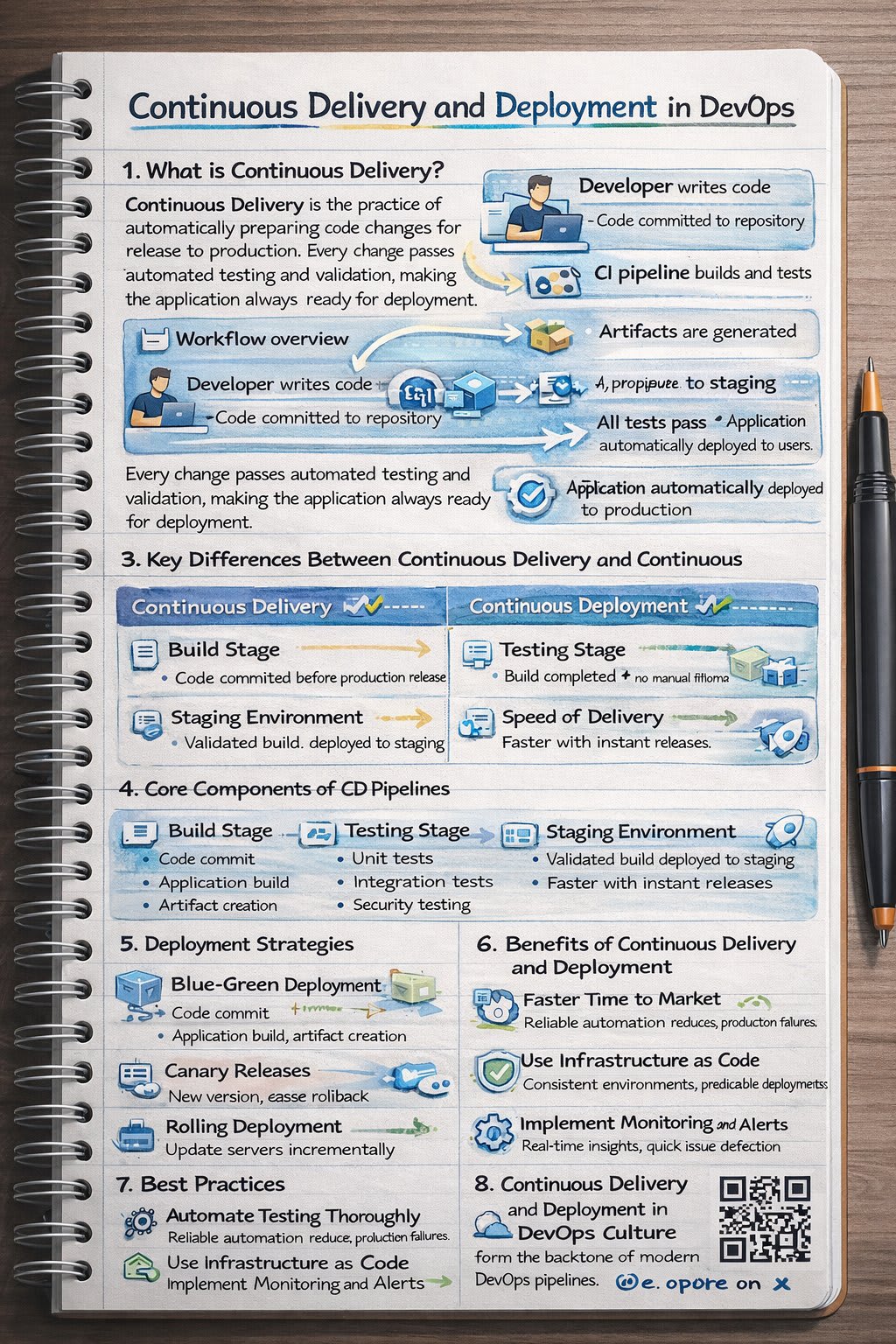
- What is Continuous Delivery?
Continuous Delivery is the practice of automatically preparing code changes for release to production. Every change passes through automated testing and validation, making the application always ready for deployment.
Workflow overview
Developer writes code → Code committed to repository → CI pipeline builds and tests → Artifacts are generated → Application is deployed to staging → Manual approval required → Production deployment
Continuous Delivery ensures that deployments are predictable and low-risk, while still allowing human control over releases.
- What is Continuous Deployment?
Continuous Deployment goes one step further by automatically releasing every validated change to production without manual approval.
Workflow overview
Developer writes code → Code committed to repository → CI pipeline builds and tests → All tests pass → Application is automatically deployed to production
This approach enables rapid delivery of features and fixes to users.
- Key Differences Between Continuous Delivery and Continuous Deployment
Release Control
Continuous Delivery → Requires manual approval before production release
Continuous Deployment → Fully automated release with no manual intervention
Risk Management
Continuous Delivery → Human verification reduces risk
Continuous Deployment → Relies entirely on automated testing and monitoring
Speed of Delivery
Continuous Delivery → Slower due to approval step
Continuous Deployment → Faster with instant releases
Use Case
Continuous Delivery → Suitable for enterprises requiring strict compliance
Continuous Deployment → Ideal for startups and fast-moving applications
- Core Components of CD Pipelines
A robust CD pipeline includes several automated stages.
Build Stage
Code commit → application build → artifact creation
Testing Stage
Build completed → unit tests → integration tests → security testing
Staging Environment
Validated build → deployed to staging → real-world simulation
Production Deployment
Staging approved → deployed to production → users receive updates
- Deployment Strategies
To minimize risk, teams use advanced deployment strategies.
Blue-Green Deployment
Two identical environments → one active (live) → one idle (new version) → traffic switched after validation
Canary Releases
New version released to small group → monitor performance → gradually increase rollout
Rolling Deployment
Update servers incrementally → no downtime → continuous availability
- Benefits of Continuous Delivery and Deployment
Faster Time to Market
Automated pipelines → quicker releases → faster feature delivery
Reduced Risk
Frequent small updates → easier rollback → fewer large failures
Improved Quality
Continuous testing → early bug detection → stable releases
Enhanced User Experience
Regular updates → faster bug fixes → improved performance
- Best Practices
Automate Testing Thoroughly
Reliable automation → reduces production failures
Use Infrastructure as Code
Consistent environments → predictable deployments
Implement Monitoring and Alerts
Real-time insights → quick issue detection
Enable Rollback Mechanisms
Deployment failure → quick recovery
- Continuous Delivery and Deployment in DevOps Culture
CD practices promote:
Collaboration between teams → faster feedback loops → continuous improvement → high deployment confidence
They form the backbone of modern DevOps pipelines, enabling organizations to deliver software efficiently at scale.
Download the full DevOps ebook: codewithdhanian.gumroad.com/l/yiirl